
Pterygium Explained: Causes, Clinical Features, Evaluation and Medical Management
A complete ophthalmology lecture article on pterygium, covering etiopathogenesis, clinical features, grading, visual effects, clinical evaluation, differential diagnosis and medical management.
What is Pterygium?
Pterygium is a chronic ocular surface disease characterized by fibrovascular proliferation and progressive corneal involvement.
Clinically, it appears as a triangular fibrovascular growth arising from the bulbar conjunctiva and extending onto the cornea. It most commonly develops on the nasal side within the interpalpebral area.
The lesion contains fibrous tissue and vascular tissue, and over time it gradually crosses the limbus onto the corneal surface. This crossing of the limbus is an important clinical feature of pterygium.
The word pterygium comes from the Greek word pteryx, meaning wing, because the lesion has a wing-shaped appearance.
Modern Understanding of Pterygium
Historically, pterygium was considered mainly a degenerative condition. However, modern understanding recognizes pterygium as a progressive proliferative ocular surface disease.
This means that active proliferation occurs at the level of the conjunctival and limbal tissues. The most important structure involved in the disease process is the limbus.
Role of the Limbus
The limbus is the junction between the cornea and the conjunctiva. It contains limbal stem cells that help maintain the normal corneal epithelium.
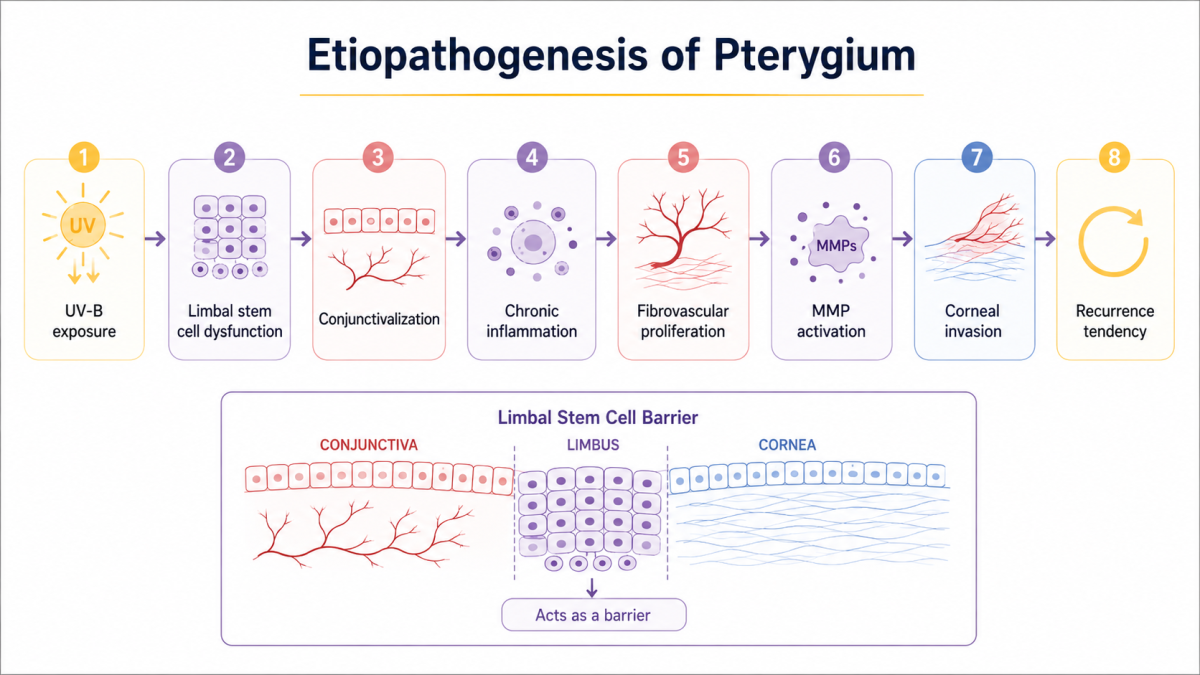
Functionally, the limbus acts as a biological barrier between the conjunctiva and the cornea. When this barrier becomes dysfunctional, conjunctival tissue can migrate onto the corneal surface. This process is known as conjunctivalization of the cornea.
Etiopathogenesis of Pterygium
Pterygium is strongly associated with chronic ultraviolet exposure, especially in patients with prolonged outdoor exposure in hot, dry and dusty environments.
Common risk groups include farmers, laborers, field workers, construction workers and individuals with long-term sunlight exposure. This is why pterygium is more common in tropical and equatorial regions where ultraviolet exposure is higher.
UV-B Damage and Limbal Dysfunction
Chronic ultraviolet exposure, especially UV-B radiation between 280–315 nm, produces repeated oxidative damage at the limbus.
This gradually leads to dysfunction of the limbal stem cell niche present within the Palisades of Vogt. Once the limbal barrier becomes compromised, conjunctival tissue can migrate onto the cornea.
Inflammation and Fibrovascular Proliferation
Along with limbal dysfunction, chronic inflammation plays an important role. Inflammatory mediators and cytokines promote fibrovascular proliferation, making the lesion more vascular, thickened and progressive.
Matrix Metalloproteinases
Matrix metalloproteinases, or MMPs, help break down extracellular matrix components and Bowman layer. Bowman layer is the acellular layer lying just below the corneal epithelium.
MMPs can be thought of as molecular scissors that help the fibrovascular lesion invade onto the cornea. Once Bowman layer is disrupted, the lesion can progressively extend further over the corneal surface.
Why is Pterygium More Common on the Nasal Side?
Pterygium occurs predominantly on the nasal side. One proposed explanation is the peripheral light focusing effect, where oblique ultraviolet rays become concentrated near the nasal limbus.
The temporal limbus is relatively protected because the nose partially blocks oblique rays from concentrating on the temporal side.
Therefore, the nasal limbus receives more focused ultraviolet exposure, contributing to limbal damage and pterygium formation.
Why Can Pterygium Recur After Surgery?
Recurrence can occur even after surgical excision because surgery removes the visible lesion, but the underlying abnormal ocular surface environment may still persist.
Important mechanisms of recurrence include residual inflammation, abnormal limbal cells, fibrovascular activity, ongoing cytokine signaling, persistent ultraviolet exposure and continued limbal barrier dysfunction.
This is why recurrence prevention is one of the most important goals of pterygium surgery.
Clinical Features of Pterygium
Clinically, pterygium appears as a triangular fibrovascular growth arising from the bulbar conjunctiva and extending onto the cornea. It most commonly occurs on the nasal side.
The appearance may vary from a small atrophic lesion to a thick, fleshy, vascular growth depending on the stage and activity of the disease.
Parts of Pterygium
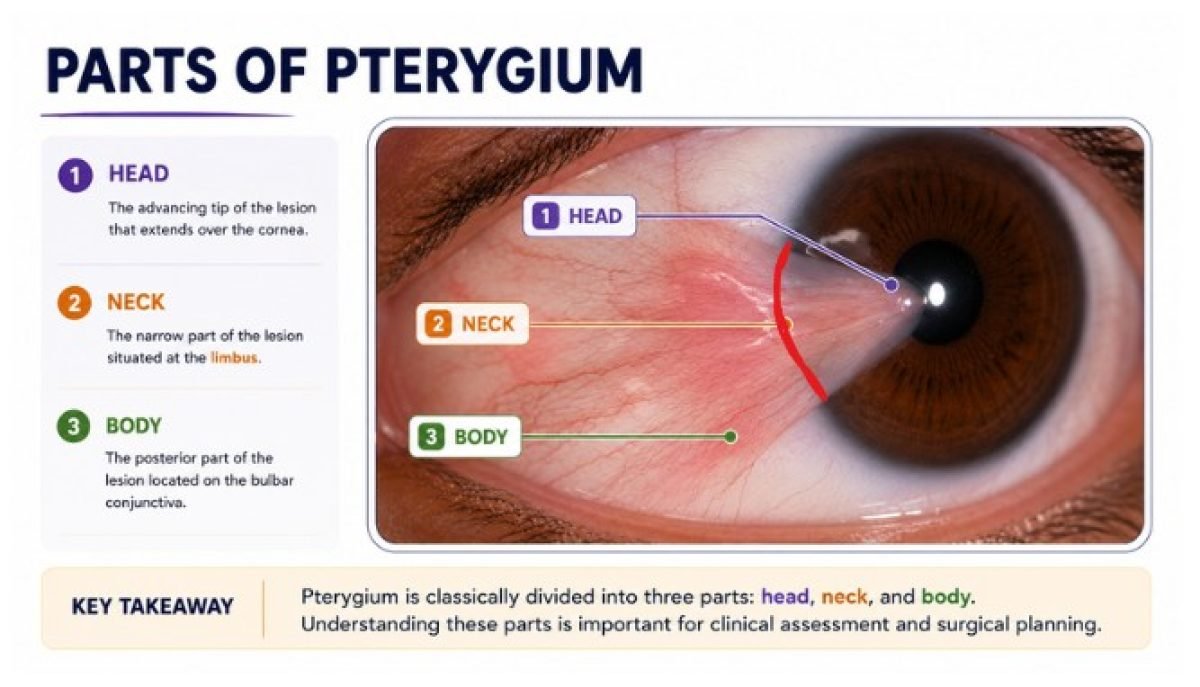
Clinically, pterygium is divided into three parts:
- Head: the advancing part over the cornea and usually the most active part of the lesion.
- Neck: the portion near the limbus.
- Body: the conjunctival part lying over the sclera.
Occasionally, a pterygium may be present on both the nasal and temporal sides of the same eye. This is called a double pterygium or bi-headed pterygium.
Common Symptoms
Patients may present with chronic redness, irritation, foreign body sensation, watering, burning sensation and dryness. These symptoms occur because the lesion disturbs the normal ocular surface and tear film stability.
Some patients remain asymptomatic in the early stages and present mainly because of cosmetic concern. As the lesion progresses further onto the cornea, visual symptoms may start developing.
How Does Pterygium Affect Vision?
Pterygium can affect vision even before it reaches the visual axis. This happens because it alters both corneal optics and tear film stability.
Pterygium-Induced Astigmatism
As the fibrovascular tissue extends onto the cornea, it exerts traction along the horizontal meridian. This gradually flattens the horizontal meridian and makes the vertical meridian relatively steeper.
This classically induces with-the-rule astigmatism, which is an important viva point.
Initially, the induced astigmatism may be relatively regular. However, as the lesion progresses, the corneal surface becomes increasingly irregular, producing irregular astigmatism and progressive visual distortion.
Patients may complain of blurred vision, distorted vision, glare, ghosting, shadowing and frequent changes in spectacle number.
Tear Film Instability
The elevated irregular surface of the pterygium disturbs the normal distribution of the tear film. This creates localized tear film instability and contributes to fluctuating vision, irritation and dryness.
Sometimes adjacent localized corneal drying may occur. This is known as Dellen formation.
Importance in Cataract and Refractive Surgery
Advanced pterygium can alter keratometry readings, corneal topography and intraocular lens power calculation. Therefore, significant pterygium may need to be treated before cataract surgery or refractive surgery planning.
Grading and Classification of Pterygium
Grading by Corneal Encroachment
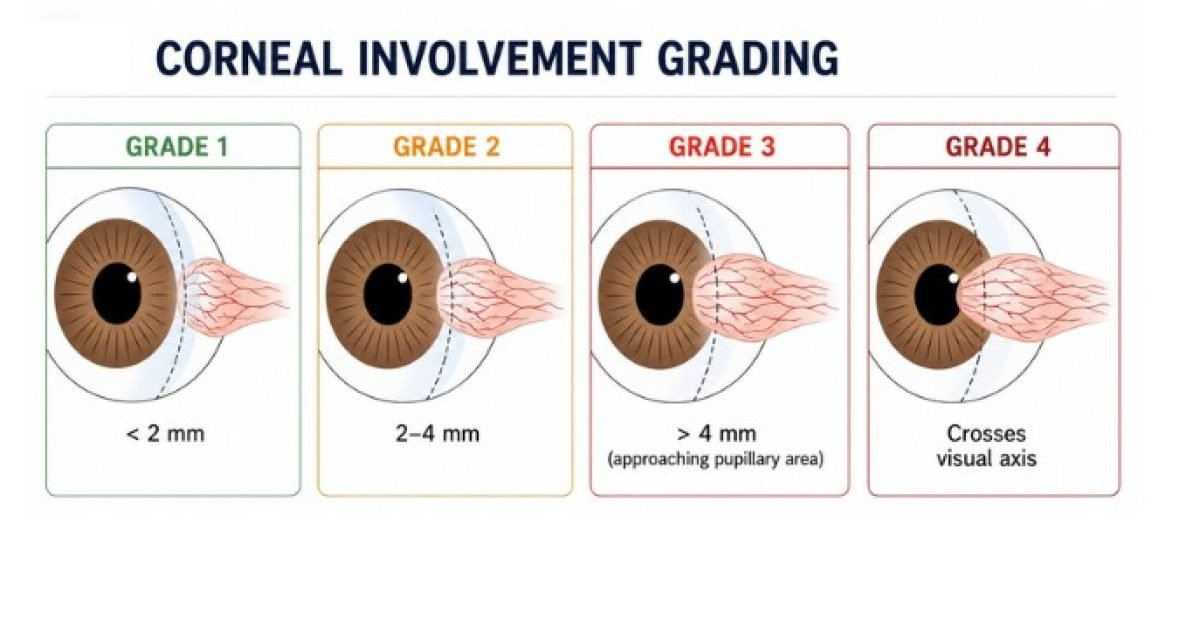
Pterygium can be graded according to the extent of corneal involvement.
| Grade | Corneal Involvement | Clinical Significance |
|---|---|---|
| Grade 1 | Less than 2 mm | Mild corneal encroachment |
| Grade 2 | 2–4 mm | Moderate involvement |
| Grade 3 | More than 4 mm | Approaching pupillary area |
| Grade 4 | Crosses visual axis | Visually significant |
This grading is clinically important because increasing corneal involvement is associated with greater visual symptoms, induced astigmatism and surgical significance.
Active Versus Inactive Pterygium
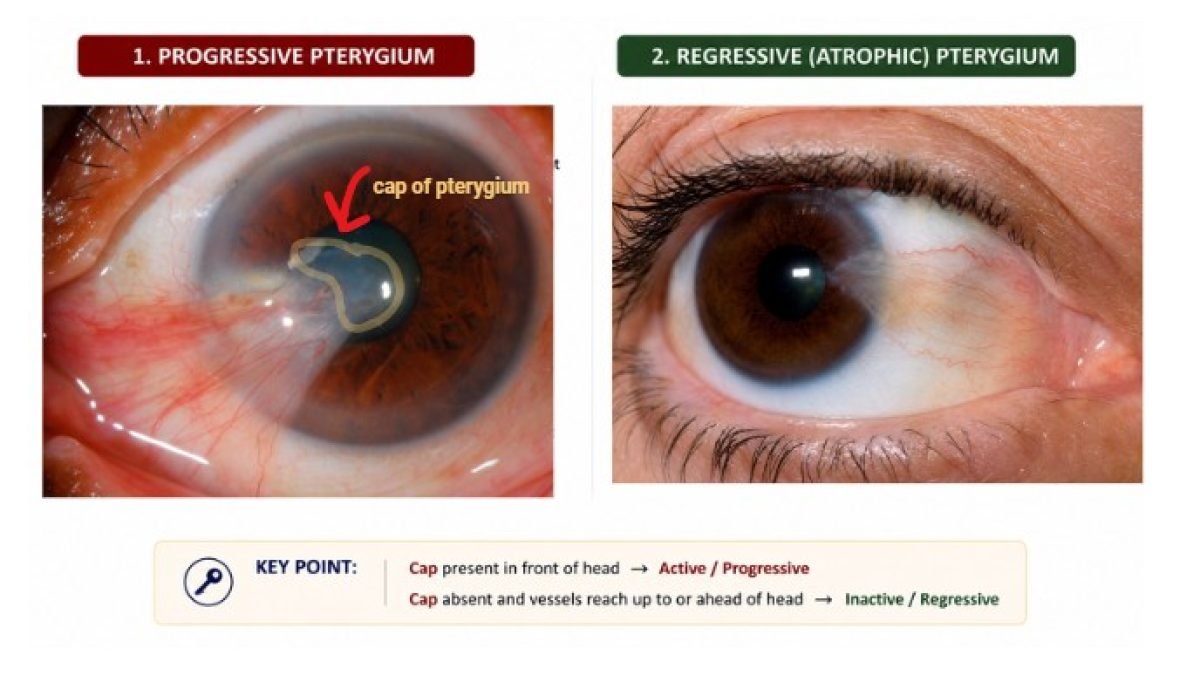
Active or progressive pterygia appear thick, fleshy, congested and highly vascular. They usually have greater tendency for progression and recurrence.
Inactive or atrophic pterygia appear thin, pale, less vascular and relatively stable.
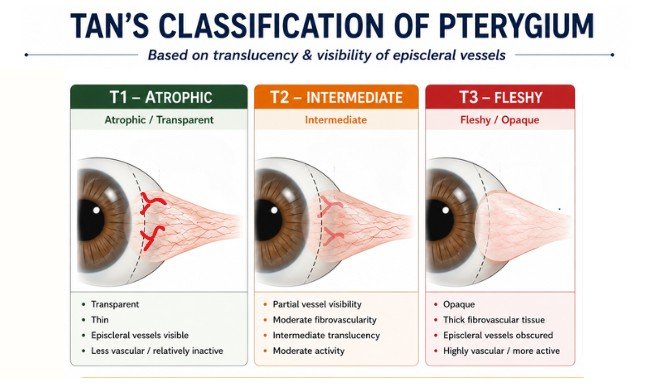
Tan Classification
Tan classification is based on the translucency of the pterygium and the visibility of episcleral vessels beneath the body of the lesion.
| Tan Grade | Appearance | Episcleral Vessel Visibility |
|---|---|---|
| T1 | Atrophic | Clearly visible |
| T2 | Intermediate | Partially obscured |
| T3 | Fleshy | Completely obscured |
Stocker Line
Stocker line is a line of iron deposition seen anterior to the advancing head of a pterygium. It is usually seen in long-standing lesions and is an important slit-lamp finding.
Clinical Evaluation of Pterygium
When evaluating a patient with pterygium, we are not simply looking at the lesion. We are trying to assess how active the lesion is, how much corneal involvement is present, how much visual distortion is occurring and whether the patient may require surgery.
History Taking
Important history points include:
- Duration of the lesion
- Progression in size
- Redness and irritation
- Watering and foreign body sensation
- Dryness
- Visual symptoms
- Frequent change in spectacle number
- Occupational ultraviolet exposure
- History of previous pterygium surgery
Previous surgery is important because recurrent pterygium is surgically more difficult. Tissue planes may be distorted and scarred.
Slit-Lamp Examination
During slit-lamp examination, evaluate the location, vascularity, thickness, extent of infiltrate, corneal involvement, activity of the lesion, Stocker line and surrounding ocular surface condition.
The advancing head should be carefully examined to determine how far the lesion has progressed onto the cornea.
Refraction, Keratometry and Corneal Topography
Refraction is important because pterygium can induce significant astigmatism and visual distortion.
Keratometry and corneal topography are useful in selected cases such as moderate to advanced pterygium, visually significant astigmatism, progressive lesions and preoperative planning before cataract or refractive surgery.
Tear Film and Ocular Surface Assessment
Since pterygium disturbs tear film stability, selected patients may benefit from tear film breakup time assessment, ocular surface staining and evaluation of tear film quality.
Differential Diagnosis of Pterygium
While evaluating a patient with pterygium, it is important to keep the differential diagnosis in mind. This is also a commonly asked examination topic.
The important differential diagnoses include:
- Pseudopterygium
- Pinguecula
- Ocular surface squamous neoplasia
- Limbal dermoid
Pseudopterygium
Pseudopterygium usually occurs secondary to trauma, inflammation or chemical injury.
Unlike true pterygium, it may occur at any position around the limbus and is not typically restricted to the nasal interpalpebral area.
An important clinical point is that a probe can often be passed beneath the neck of a pseudopterygium. This is known as the probe test.
Pinguecula
Pinguecula remains confined to the conjunctiva and does not cross onto the cornea.
It usually appears as a yellowish elevated conjunctival degeneration near the limbus, whereas pterygium is more fibrovascular in appearance and progressively extends onto the cornea.
Ocular Surface Squamous Neoplasia
Ocular surface squamous neoplasia may show abnormal vascularity, irregular surface changes, leukoplakia and atypical growth patterns, often with a feeding vessel.
Limbal Dermoid
Limbal dermoid usually appears as a congenital, well-circumscribed yellowish-white lesion near the limbus.
Medical Management of Pterygium
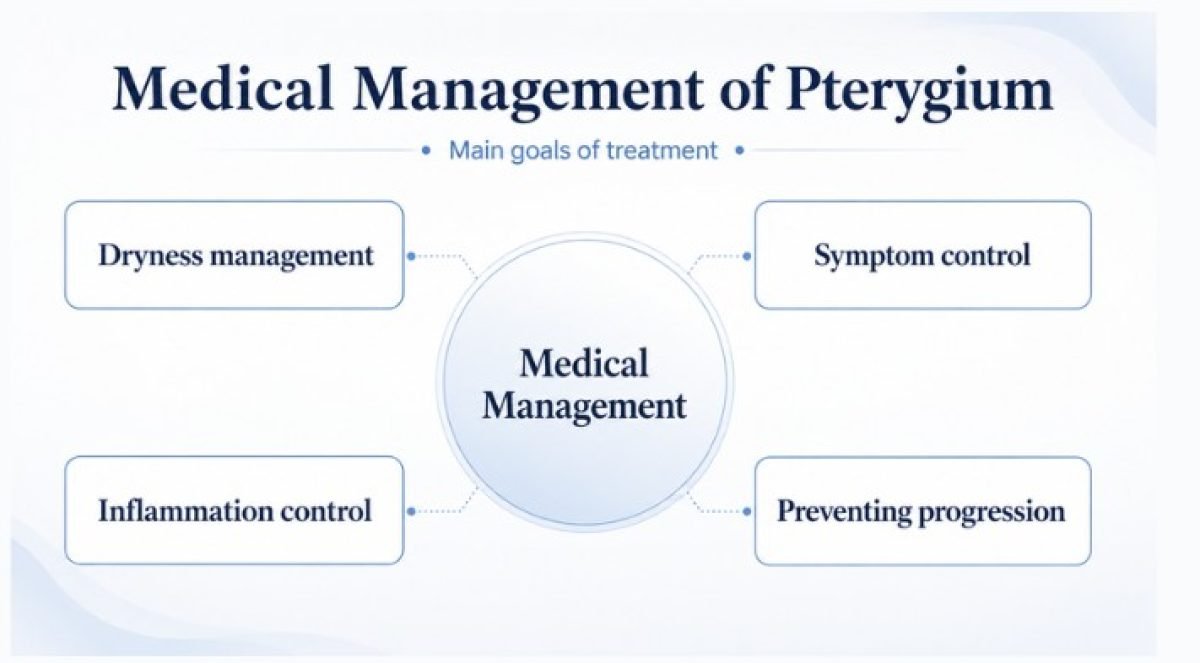
Medical management does not remove the pterygium. It mainly helps in controlling symptoms, ocular surface inflammation, dryness and irritation.
The main components of medical management include lubrication, ultraviolet protection, control of inflammation and ocular surface optimization.
Lubrication
Ocular lubrication is the most basic component of medical management. Commonly used lubricants include:- Carboxymethylcellulose
- Hydroxypropyl methylcellulose
- Preservative-free artificial tears
Ultraviolet Protection
Patients should be advised to reduce excessive sunlight exposure whenever possible. Protective eyewear and UV-blocking sunglasses are important, especially wraparound UV-protective sunglasses that reduce peripheral ultraviolet exposure. This is particularly important in patients with outdoor occupations such as farming, construction work or prolonged field exposure.Anti-inflammatory Therapy
During episodes of active inflammation, short courses of topical anti-inflammatory medication may be used. Commonly used topical steroids include:- Fluorometholone
- Loteprednol
- Short supervised courses of prednisolone acetate in selected patients
Quick Revision Notes
| Definition | Fibrovascular conjunctival growth extending across the limbus onto the cornea. |
| Common site | Nasal interpalpebral conjunctiva. |
| Key risk factor | Chronic ultraviolet exposure, especially in hot, dry and dusty environments. |
| Important structure | Limbus and limbal stem cell barrier. |
| Pathogenesis | UV damage → limbal dysfunction → conjunctivalization → inflammation → MMP activity → corneal invasion. |
| Classical astigmatism | With-the-rule astigmatism. |
| Tan classification | Based on translucency and visibility of episcleral vessels. |
| Medical treatment | Lubrication, UV protection and short supervised anti-inflammatory therapy when needed. |
Frequently Asked Questions
What is pterygium?
Pterygium is a fibrovascular growth of conjunctival tissue that crosses the limbus and extends onto the cornea.Why is pterygium commonly seen on the nasal side?
Pterygium is more common nasally because of peripheral light focusing and greater ultraviolet concentration near the nasal limbus.Can pterygium affect vision?
Yes. Pterygium can affect vision by inducing astigmatism, disturbing tear film stability and, in advanced cases, encroaching toward the visual axis.What type of astigmatism is commonly caused by pterygium?
Pterygium classically induces with-the-rule astigmatism due to flattening of the horizontal corneal meridian.Does medical management remove pterygium?
No. Medical management does not remove the pterygium. It helps reduce dryness, irritation, redness and ocular surface inflammation.When is surgery considered?
Surgery is considered when pterygium is progressive, visually significant, cosmetically concerning, symptomatic despite medical treatment or interfering with cataract or refractive surgery planning.Key Takeaway
Pterygium is not just a harmless conjunctival growth. It is a chronic ocular surface disease involving ultraviolet damage, limbal dysfunction, inflammation, fibrovascular proliferation and progressive corneal involvement. Clinically, every case should be assessed for activity, corneal encroachment, induced astigmatism, tear film disturbance and impact on cataract or refractive surgery planning. Medical management helps control symptoms and ocular surface inflammation, but progressive or visually significant pterygium may require surgical management. Watch the complete lecture above for a step-by-step explanation with diagrams and clinical examples.Want to learn the surgical management of pterygium?
Read the next article here: Pterygium Surgery: Indications, Techniques, Graft Fixation, Recurrence and Complications